You are about to go to a website for healthcare professionals.
This information is intended only for healthcare professionals in the US. If you are a healthcare professional, click “I agree” to continue.

If you click “Continue” below, you will leave the current site and be taken to a site maintained by a third party that is solely responsible for its content. Amgen provides this link as a service to website visitors. Amgen is not responsible for the privacy policy of any third-party websites. We encourage you to read the privacy policy of every website you visit.

High LDL-C is a leading risk factor for a heart attack and stroke. If you have had a heart attack or stroke, you are most likely to experience another cardiovascular event within the first year.
Despite its dangers, There are
NO SYMPTOMS
OF HIGH LDL-C


Yes. If you have cardiovascular disease, you’re still at risk for future heart attacks or strokes, especially if your LDL-C is too high. Your risk level depends on different factors, including your medical history and whether you have additional conditions. Your doctor can help you determine your risk level.
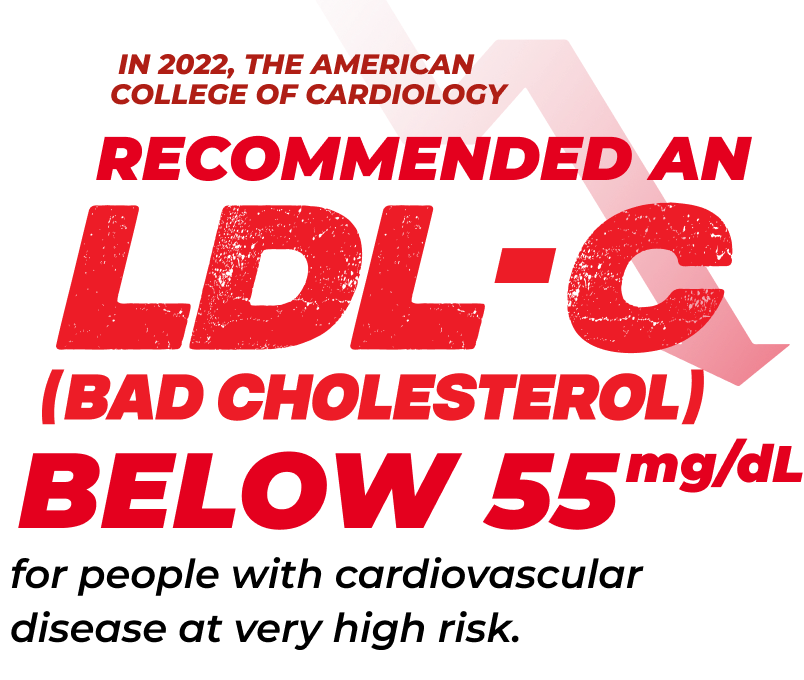
Different factors can put you at very high risk for another heart attack or stroke (see the full chart below for some of the most common ones). If you are at very high risk, an LDL-C below 55 mg/dL is recommended by the American College of Cardiology, along with the American Heart Association and other Medical Societies to reduce the risk of another heart attack or stroke.
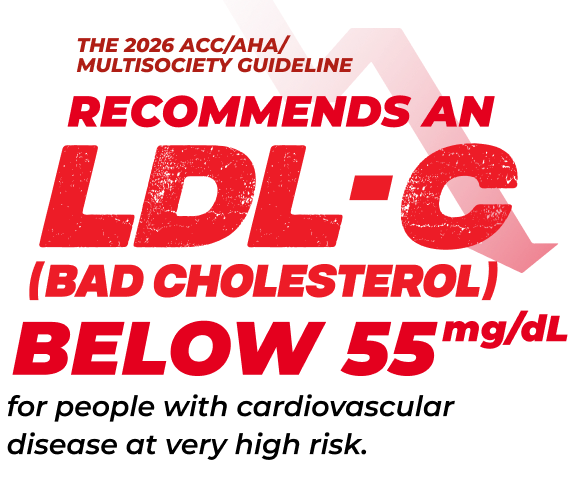
Based on the 2026 ACC/AHA/Multisociety treatment Guideline


Having high LDL-C (bad cholesterol) can be dangerous. But you can't feel it. That's why the first steps to understanding your risk level are getting your LDL-C tested and talking to your doctor.
†Terms and conditions apply. Programs subject to change; quantities may be limited.
You've heard their stories. Now learn how to
get a free LDL-C testTerms and conditions apply. Programs subject to change; quantities may be limited.